labels: Oil & gas
BP, ConocoPhillips join hands to build $30 billion Alaskan gas pipeline news
09 April 2008

BP and ConocoPhillips announced today that they have combined resources to start work on Denali, the Alaska gas pipeline. The pipeline will move approximately four billion cubic feet of natural gas per day to markets, and will be the largest private sector construction project ever built in North America. The volume of gas to be transferred would account for 8 per cent of the US daily consumption.

The joint operation combines the financial strength, arctic experience and technical resources of two of the most capable and experienced oil and gas exploration and refining companies in the world.
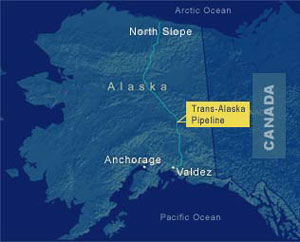
This announcement would come as a blow to TransCanada Corp., which had earlier emerged the frontrunner to bring untapped Alaskan gas to the market. The company already has a massive gas pipeline network in Alberta, but with Western Canadian supply declining, the company needs to seek out new frontier opportunities, such as Arctic gas.

Alaska has always been a source of encouragement as well as consternation for the world's major energy companies. While they always knew that the distant American state holds prodigious amounts of natural gas – an estimated 35 trillion cubic feet – plans for exploitation have been held up due to cost and regulatory constraints.

An earlier pipeline proposal by BP, ConocoPhillips and Exxon was quashed by Alaska's legislature in 2006.

It was only last year that Alaskan Governor Sarah Palin introduced new legislation to restart the process, soliciting bids from interested companies. In January, she said TransCanada's pipeline plan would be the only proposal officially considered by the state, which is expected to decide whether to grant a licence later this year. At the same time, the legislation effectively left the door open to shippers to propose rival pipelines – such as the one now put forward by BP and ConocoPhillips.

BP and ConocoPhillips plan to spend $600 million to reach the first major project milestone, an open season, commencing before the end of 2010. The entire project is estimated to cost a whopping $30 billion. An open season is a process during which the pipeline company seeks customers to make long-term firm transportation commitments to the project.

Following its successful completion, the companies intend to obtain Federal Energy Regulatory Commission (FERC) and National Energy Board (NEB) certification and move forward with project construction. The FERC and NEB certificates are the critical permits that provide government authorization to construct a pipeline.

Even if the new combine beats out the old contender, dispute will arise over the right to build the Canadian portion of the pipeline. While TransCanada says that it has the right to do so, citing by the Northern Pipeline Act of 1978, BP and ConocoPhillips argue that a new project like Denali would not come under the Act's jurisdiction.

Management of both companies expressed their satisfaction with the joint agreement and also spoke about the importance of Alaskan gas to address America's energy concerns.

"This project is vital for North American energy consumers and for the future of the Alaska oil and gas industry. It will allow us to keep our North Slope fields in production for another 50 years," said Tony Hayward, BP Group Chief Executive. "The Alaska gas pipeline will be an historic project and we are pleased to be working with ConocoPhillips to move it forward."

"Our goal of bringing Alaska's North Slope gas to market is becoming a reality. Denali - The Alaska Gas Pipeline project will deliver natural gas to meet North America's growing energy needs," said Jim Mulva, ConocoPhillips chairman and chief executive officer. "ConocoPhillips is pleased to be working with BP on this project; our companies have a long history of successfully developing projects on Alaska's North Slope, in Canada, and around the world. The time is right to start moving this project forward."

The project involves a lot of construction and a lot of investment, and the two partners are not averse to tying up with other companies to take the project forward. Under present plans, the project consists of a gas treatment plant on Alaska's North Slope and a large-diameter pipeline that travels over 700 miles through Alaska, and then into Canada through the Yukon Territory and British Columbia to Alberta. If other states were also to be supplied Alaskan gas, another large-diameter pipeline would extend to the lower parts of the US.

A major question hanging over the Denali project is the absence of Exxon, which owns an estimated eight trillion cubic feet of Alaskan gas reserves, the development of which would help support any new pipeline. Even though Exxon has been invited to join, such an invitation has come only ''days ago'', in their words. Hence, Exxon rejected that invitation, saying it hadn't had time to evaluate the project. However, BP and ConocoPhillips are still hopeful of Exxon's participation in one form or another.


 search domain-b
  go
 
BP, ConocoPhillips join hands to build $30 billion Alaskan gas pipeline