|
Threats and opportunities take TVS group companies into the rigorous world of absolute quality standards. Now, a couple of years after companies like Sundaram Clayton, SBL, TVS Motor have won the Deming medal, domainb.com talks to the senior management in these companies to find out how they evaluate their progress and how has implementing the suggestions made by JUSE helped their operations Chennai: If there is one industrial group that has been infected by the `Deming' bug, it is the city-based TVS group. And it is happy about it. Since 2001, one TVS group company figures in the prestigious Deming Application prize winners announced by the Union of Japanese Scientists and Engineers (JUSE). Incidentally, group company, Sundaram Clayton Limited, became the first Indian company in 1998 to win the Deming medal. The company's brakes division became the proud recipient of the prestigious award.  | | Five pillars of TQM | Other group companies to have been awarded the Deming medal have been Sundaram Brake Linings Limited (SBL) in 2001, TVS Motors Limited in 2002 and Brakes India Limited's foundry division in 2003. And this year, it was Lucas TVS Limited, which kept alive the Deming's association with the group. But winning a Deming is not akin to becoming ISO-certified. On the other hand the total quality management (TQM) process might even involve changing a company's corporate culture. According to JUSE, the Deming is awarded to companies or divisions, which practice TQM suitable to their management practices, their business and the industry they operate in.
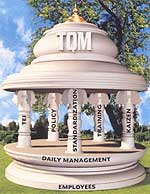
Explaining the TQM process at Sundaram Clayton, Venu Srinivasan, managing director, (and also chairman and managing director of sister company, TVS Motor - another Deming recipient - ) says, "It is a company-wide effort at continuous quality improvement of all processes, products and services through total employee involvement, that results in increasing customer satisfaction and loyalty, and improved business results." Interestingly, the TVS group adapted to the TQM concepts and assimilated them in its own 'TVS culture' to the extent that the auditors from JUSE commended the TQM practices in the group as 'TVS TQM'. JUSE also examines whether the medal challenger, as the applicant is referred to, has established 'challenging customer-oriented business objectives and strategies under clear leadership' and precisely how TQM was implemented to achieve them. JUSE also assesses whether the company has scored 'outstanding achievement' in its business objectives and strategies after implementing TQM. According to JUSE, TQM is a set of systematic activities carried out by the entire organisation to achieve effectively its objectives to provide products or services at a quality that satisfies customers at the appropriate time and price. And the shortest way to Deming is to undertake only those activities that are really necessary for its business and which are unique to its business and scale. For all the TVS group winners, it was a hard grind before they won the Deming. However, it has been worth it all as the benefits have helped beef up the top and bottom lines of each of the recipients. "The award certainly puts the company on a higher pedestal straightaway," remarks SBL's chairman and managing director, K Mahesh. "Though many companies outside India are not familiar with the Deming prize, they know that it is the highest recognition in a company's quest for total quality." Adds Srinivasan, "TVS Motor experienced significant increase in sales after receiving the Deming medal. Our turnover, which was around Rs1,940 crore in 2001-02, went up over Rs2,700 crore in 2002-03 and to Rs2,856 last fiscal. The projection for the current fiscal is Rs3,200 crore."(See: Zipping in the fast lane). Winning the medal is not an end in itself. It is like catching a tiger by its tail. Any slackening in the quality process impacts the bottomline immediately and later the topline. Naturally, businesses keep an eagle eye to spot any variance and take immediate corrective action. As there is always scope for continuous improvement and to encourage companies to aim higher, JUSE also awards the Japan Quality Medal (JQM) - considered a cut above the Deming. Three years after winning the Deming medal, companies have to submit a status report to JUSE. At this stage they can also challenge the JQM. By the time a company challenges the JQM, all the employees would have imbibed the TQM process and procedures, which, by then, will have become a way of life for every one in the company. In 2002, Sundaram Clayton became the first Indian company and the second outside Japan to bag the JQM. "The Deming award is just a milestone in a company's TQM journey," remarks Mahesh. According to him, "The race for quality has no finishing line." Not surprisingly, all the Deming awardees in the TVS group have reported enviable performance record. For instance, the Rs230-crore Brakes India's foundry division works continuously to improve upon the value addition in order to become a Tier-I supplier to original equipment manufacturers (OEMs) from its status of a Tier-II / Tier III supplier. Says executive director V Narasimhan, "Unlike normal foundries that work with customer drawings and specifications, we are increasingly getting involved with product design through collaborative efforts with our customers. We differentiate ourselves by getting more and more involved at the design stage itself." (See: Excelling through technological leadership) He elaborates, "The Deming award has considerably enhanced our status in the domestic and the export markets and has helped us become the largest exporter of automotive castings from India besides also becoming the largest automated ductile iron foundry in India." The foundry turns out around 42,000 tonnes per annum of ductile iron and permanent mould castings and has sustained an enviable 35 per cent growth year-on-year for the last three years. Similarly, all the companies have taken appropriate steps to incorporate the suggestions made by JUSE during the audit for the Deming medal. According to SBL's Mahesh, after implementing JUSE's suggestions, the company's sales, compared to its nearest competitor, have not only improved substantially; the gap is continuously widening in its favour in the automotive friction material segment. Moreover, the company has also used the suggestions to develop new products such as asbestos-free composite brake blocks for the Indian Railways. (See: SBL to chug fast on rail track) It has supplied a pilot batch of 1,800 brake blocks to Indian Railways and expects a sales volume of Rs9 crore in the next three years. Similarly, TVS Motor, in keeping with JUSE's recommendation to have an integrated approach to its brand recognition strategy, strengthened the brand image and visibility using brand ambassadors for its two-wheelers - like cricketer Sachin Tendulkar for TVS Victor and actress Priety Zinta for Scooty Pep. (See: Zipping in the fast lane) At a time when many TVS group companies have embraced TQM with missionary zeal, Sundram Fasteners Limited is happy following total productivity maintenance (TPM). It was the first Indian company to get an ISO certification. The company has been winning the 'supplier of the year' awards from the US giant, General Motors, and has won TPM awards from the Japanese Institute of Plant Maintenance (JIPM). Pioneering the TPM movement in India, chairman and managing director Suresh Krishna explains why Sundram Fasteners is not looking at the Deming award, "Both TPM and TQM aim to reach the same destination. I am happy and satisfied with my path."
also see : Resting
on TQM
|