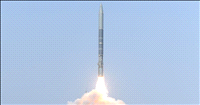
INSAT-4B launched successfully
12 Mar 2007
Chennai: The Indian Space Research Organisation's (ISRO) latest communication satellite, Insat-4B, was successfully launched early this morning by the European Ariane-5 ECA launch vehicle of Arianespace.
The 3,025 kg Insat-4B is the second satellite in the INSAT-4 series. An identical satellite, Insat-4A, was launched by Ariane-5 on December 22, 2005.
With 12 high power Ku-band transponders and 12 C-band transponders, Insat-4B will further augment the Insat capacity for Direct-To-Home (DTH) television services and other communication and TV services. With the addition of Insat-4B, the communication capacity will be further increased to 199 transponders from the present 175 transponders.
The 31st flight in Ariane-5 series, carrying ISRO's satellite along with the EADS Astrium Skynet-5A, lifted off at 03:33 am Indian Standard Time (IST) from Kourou, French Guyana.
About 30 minutes after lift-off, Insat-4B was placed in the Geosynchronous Transfer Orbit (GTO) in 3-axis stabilised mode. The satellite is now orbiting the earth with a perigee (nearest point to earth) of 243 km and an apogee (farthest point to earth) of 35,876 km and an inclination of 4.52 deg with respect to the equator. The orbital period is about 10 hours 34 minutes.
The Master Control Facility (MCF) at Hassan in Karnataka received the first signals from Insat-4B at 4:02 am IST. The initial checks on the satellite have indicated satellite's normal health. MCF subsequently issued commands to the satellite to make the earth viewing face to orient towards earth. The calibration of the gyros on board the satellite was also carried out.
The satellite is being tracked, monitored and controlled from MCF. During the initial phase operations, MCF also utilises INMARSAT Organisation's Telemetry, Tracking and Command (TTC) ground stations at Beijing (China), Fucino (Italy) and Lake Cowichan (Canada) besides the ISRO Telemetry, Tracking and Command (ISTRAC) Network station at Biak in Indonesia. The satellite's orbit is being precisely determined by continuous ranging from the participating ground stations.
In the coming days, Insat-4B will be manoeuvred to its final geostationary orbit, which is about 36,000 km above the equator, by firing its 440 Newton Liquid Apogee Motor (LAM). When the satellite reaches near geosynchronous orbit, deployment of its solar panels and the two antennas will be carried out and the satellite put in its final 3-axis stabilised mode.
This
will be followed by trim manoeuvres to take the satellite
to its designated orbital slot at 93.5 degree East longitude
where it will be co-located with Insat-3A. The payloads
will be checked out before the commissioning of the
satellite.
Measuring 15.4 metre with its solar arrays are fully
deployed in orbit Insat-4B will be 3-axis body stabilised
in orbit using earth sensors, momentum and reaction
wheels, magnetic torquers and eight 10 Newton and eight
22 Newton Reaction Control Thrusters. The satellite
has two solar arrays together generating 5,860 Watt
of electrical power backed up by three 100 Ah Lithium-Ion
Batteries.
The
satellite has two deployable antennas for various transmit
and receive functions.
With
ISRO Satellite Centre (ISAC), Bangalore, as the lead
centre, Insat-4B was realised with major contributions
from Space Applications Centre (SAC), Ahmedabad, Liquid
Propulsion Systems Centre (LPSC) at Valiamala and Bangalore,
Vikram Sarabhai Space Centre (VSSC) and ISRO Inertial
Systems Unit (IISU) at Thiruvananthapuram and Laboratory
for Electro Optic Sensors at Bangalore.